
Youth sports safety usually gets talked about in the past tense.
A player goes down. There’s a quiet drive to urgent care. A parent group chat lights up. Somebody says the field has needed work for years. And then the season moves on, because there’s a game on Thursday and someone has to bring the snacks.
The uncomfortable truth is that by the time that conversation happens, the decisions that mattered were already made — months earlier, by people who had no idea they were making them.
Injury awareness is not something you apply after an injury. It’s something you apply before anyone steps onto the field.
The decisions that get made in the off-season
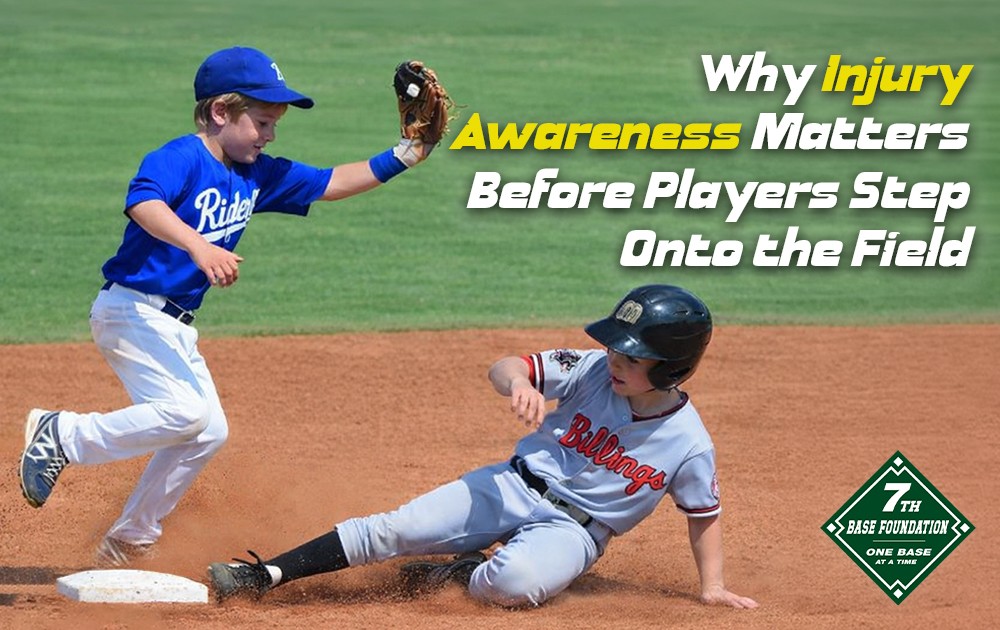
Think about what actually determines whether a young athlete gets hurt sliding into second base in June.
It isn’t the slide. Slides are constant; kids will slide the same way in every league in the country. What varies is what they slide into — and that was determined back in February, when a league board sat around a table and decided where the money was going.
Uniforms. Umpire fees. Insurance. Field prep. Balls. Maybe a scoreboard repair. The bases came up, or they didn’t. Somebody said “they’ve got a few more seasons in them,” and that was that.
That meeting is where the injury was prevented or wasn’t. Everything after it is just waiting to find out.
This is why awareness has to come first. A parent who understands base safety in March can ask a question that changes the budget. A parent who understands it in June can only ask what happened.
What most people don’t know
The single most useful fact in youth baseball safety is one that almost nobody involved in youth baseball has heard.
Reporting compiled by the Centers for Disease Control and Prevention, the Journal of the American Medical Association, and other outlets has estimated that sliding into stationary bases is responsible for roughly 71% of injuries in recreational baseball and softball.
Not collisions in the outfield. Not pitching arms. Not foul balls in the dugout. Bases.
Say that number to a group of youth coaches and watch the reaction. Most of them have been around the sport for years. Most of them have never heard it.
It’s worth sitting with why. Helmets are visible — you can see a kid wearing one. Pitch counts are tracked on a clipboard. Concussion protocols come with paperwork. Base safety has no visible ritual attached to it. The base is just there, part of the scenery, as unquestioned as the foul lines.
Awareness means seeing the base as equipment that either protects a child or doesn’t, rather than as part of the landscape.
Why the pre-season window is the one that counts
There are practical reasons the “before” matters as much as the awareness itself.
Budgets get locked early. Once a league’s season budget is set, it is very hard to reopen. A safety conversation in January can change a line item. The same conversation in May gets a sympathetic nod and a “next year.”
Equipment takes time. Ordering, delivery, and installation don’t happen in a weekend. A league that decides to upgrade in March can play the whole season on safer bases. One that decides in June is upgrading for next year’s players.
Funding has a calendar too. The Seventh Base Foundation aims to notify selected organizations within about a week of application — deliberately fast, because leagues plan around season start dates. But that speed only helps programs that apply before their season, not during it.
Field work is easier before play starts. Anchors, mats, and base plates are simpler to install on an empty diamond than around a full game schedule.
Every one of these argues for the same thing: the safety conversation belongs in the off-season, not the season.
What awareness looks like in practice
Awareness isn’t a feeling. It’s a short list of things you actually look at.
Look at the bases before opening day. Walk out to each bag. Is the base bolted to a metal post sunk into the ground? Does it sit completely rigid? Is the surface torn, cracked, or brittle from sun exposure? Are anchors sitting above the dirt line where a cleat can catch them?
Know what you’re looking for. A traditional stationary base is a fixed obstacle in the path of a sliding child. A breakaway base snaps onto grommets attached to an anchored rubber mat — firm through normal base running, releasing under the force of a slide. If you can’t tell which one your field has, that’s an answer in itself.
Ask the board directly. “Do we have breakaway bases, and if not, what would it take?” is a completely reasonable question from a parent, and it’s often the question that starts everything.
Check the whole approach to the bag, not just the base. The lip where infield dirt meets grass. Low spots that have washed out. Exposed hardware. The base is the biggest factor, not the only one.
Look at your coaching plan too. Are your youngest divisions being taught to slide properly, before they’re asked to do it competitively? Equipment reduces the consequences of a bad slide; instruction reduces how often one happens.
Awareness has to turn into something
Here’s where a lot of safety conversations stall. People learn the facts, feel appropriately concerned, and then run into the wall that stopped their league in the first place: there isn’t money for it.
That wall is exactly what the Seventh Base Foundation exists to remove. We fund breakaway bases for youth baseball and softball programs that can’t fund them on their own, so that a league board’s honest answer to “we can’t afford it” stops being the end of the discussion.
The pattern we’d like to see repeat itself is simple. Someone becomes aware. They ask a question. The league discovers there’s a path that doesn’t require finding money they don’t have. And a set of bases goes in before the season instead of after an injury.
The season that doesn’t make a story
The best outcome of pre-season awareness is that nothing memorable happens.
No urgent care visit. No group chat. No parent watching their kid on crutches for six weeks. No board meeting in August where everyone agrees something should have been done.
Just a season of games, played on fields where the equipment was quietly handled before anyone stepped onto them.
That’s what awareness buys — and the window to buy it is open right now, before the first practice.
If you run a league, apply for bases. If you want to help fund the next field, donate today.