
There are many ways to try to make a sport safer. You can write curriculum. You can run clinics. You can lobby for rule changes. You can campaign for awareness. You can research.
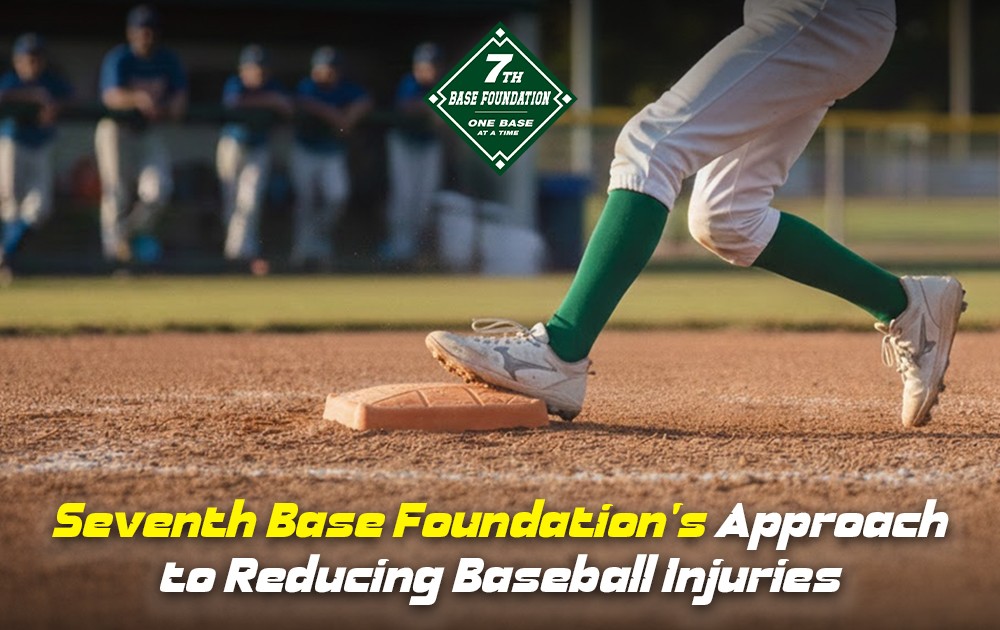
We do one thing: we put better bases on youth fields.
That narrowness is not a limitation we’re apologizing for. It’s the strategy. Here’s the reasoning behind it.
Start with where the injuries actually are
Any serious injury-reduction effort should begin by asking where the injuries concentrate, rather than where the attention does.
In youth baseball and softball, the attention goes to pitching arms, concussions, and heat. Those matter. But reporting compiled by the CDC, the Journal of the American Medical Association, and other outlets has estimated that sliding into stationary bases accounts for roughly 71% of injuries in recreational baseball and softball.
That’s the largest single injury mechanism in the sport, and it receives a fraction of the attention the others get.
When one cause accounts for the majority of harm, the highest-return strategy is not to spread effort evenly across all causes. It’s to go directly at the big one.
Then ask whether it’s solvable
A large injury category is only worth targeting if something can actually be done about it. This one can, and the evidence is unusually strong for sports medicine.
A three-phase study led by orthopaedic surgeon Dr. David Janda at the University of Michigan, published in the American Journal of Sports Medicine, found that using Rogers® Breakaway™ bases in recreational softball reduced sliding injuries by 98% and associated medical care costs by 99%. Field research has projected that widespread adoption could prevent roughly 1.7 million injuries per year in the United States, with savings exceeding $2 billion annually in health care costs.
The American Academy of Orthopaedic Surgeons recommends breakaway bases be installed on all playing fields, and encourages physicians involved in sports to promote their use in their communities. Little League International has mandated disengage-able bases in U.S. leagues since the 2008 season.
So: a dominant injury mechanism, a proven intervention, and expert consensus already in place. What’s left isn’t a knowledge problem.
Identify the actual bottleneck
This is the step most safety efforts skip.
If the research is settled and the governing bodies agree, why are stationary bases still in the ground on fields across the country?
Because a volunteer-run league operating on registration fees, snack bar revenue, and a spring raffle has to choose between bases, uniforms, umpire fees, insurance, and field maintenance — and safety equipment loses that argument more often than it should.
The bottleneck is money, not persuasion.
That diagnosis determines everything about how we work. We are not primarily an awareness campaign, because awareness isn’t the constraint. We’re a funding mechanism, because funding is.
The approach in four parts
We fund equipment directly. We provide grants and funding to youth leagues to replace old, unsafe, or non-breakaway bases with breakaway bases. Not vouchers, not matching requirements that assume a league has matching funds — direct support for programs that couldn’t otherwise make the upgrade.
We help leagues assess their fields. Our team helps leagues identify unsafe bases and offers guidance on upgrading, so that programs know what they actually have and what modern safety standards look like. A league that can’t diagnose its own field can’t prioritize fixing it.
We build partnerships that multiply reach. We collaborate with schools, leagues, and corporate sponsors to expand access to breakaway bases nationwide. A single donation reaches one field; a partnership can reach a region.
We share knowledge. We raise awareness about base safety through community outreach, social media, and partnerships with sports organizations — not because awareness alone fixes anything, but because a league that has never heard the 71% figure won’t apply for help it doesn’t know exists.
Why we’re specific about the equipment
We fund a particular system rather than whatever safety base is cheapest, and that’s a deliberate part of the method.
A study comparing the force-attenuating properties of different base types found meaningful differences between them. All breakaway brands reduced force at the ankle on impact to a statistically significant level. But Rogers® Breakaway™ bases produced the only statistically significant reduction in force at the foot. And the force delivered to the tibia and fibula was actually increased with certain other designs compared to a standard stationary base.
The researchers’ conclusion was that breakaway bases reduce impact forces and moments significantly and confirm earlier field studies — and that despite differences among them, they should be used on all fields.
We take both halves of that seriously. Any breakaway base beats a stationary one. But when we’re spending donor money, we fund the system with the strongest evidence behind it.
How we choose which programs get help
Demand exceeds our capacity, so selection has to be principled. We evaluate applications on:
- Demonstrated need for breakaway bases — how unsafe is the current equipment
- Number of athletes impacted — how many kids play on these fields
- Program need and support — what the program has, and what it can’t fund alone
- Program organization — whether there’s structure to receive, install, and maintain the equipment
And we move fast, notifying selected organizations typically within a week, because leagues operate on season calendars.
Notice what’s absent: fundraising sophistication, polish, connections. A plainly written application from a small league with real need competes well here, which is the point.
What we deliberately don’t do
We don’t run pitching mechanics programs. We don’t certify coaches. We don’t produce safety curriculum. Other organizations do those things, some of them well.
Spreading a small foundation’s resources across every safety issue in youth baseball would produce a thin layer of effort everywhere and a decisive difference nowhere. We’d rather convert fields.
The measure
Our scorecard is deliberately simple: fields converted, athletes playing on them, time from application to installed equipment, and how much of every dollar reaches a field.
One base at a time isn’t a slogan about modest ambitions. It’s a literal description of the method — identify the biggest cause of harm, fund the proven fix, and repeat it field by field until the fix is everywhere.
Learn more about our mission, or help us convert the next field.