
Youth baseball has spent generations trying to coach its way out of injuries. Teach better sliding technique. Remind players to stay alert. Post the rules. Repeat the warnings.
Coaching matters, and no one should stop doing it. But safety professionals in every industry learned the same lesson long ago: the most reliable way to reduce risk is not to ask people to behave more carefully around a hazard. It is to engineer the hazard out. Youth baseball’s version of that lesson is the base itself.
Why the Base Is an Engineering Problem
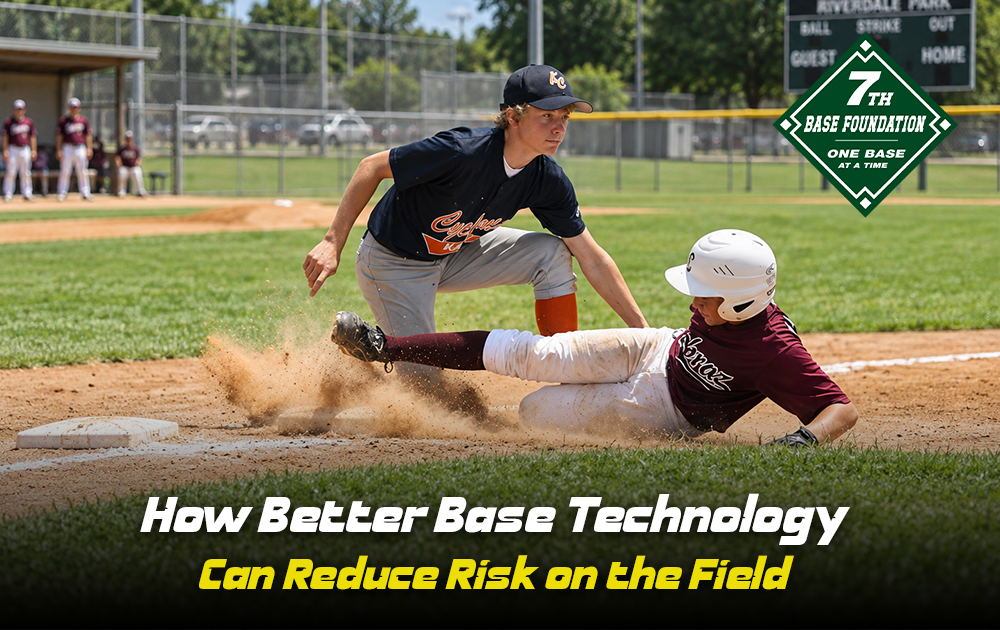
Consider what we ask of a ten-year-old on the base paths. Sprint as fast as you can. Decide in a fraction of a second whether to slide. Execute a technique you have practiced a handful of times, under game pressure, with a fielder’s glove sweeping toward you. Now do it perfectly, every time, because the object you are sliding into has no give whatsoever.
That is not a training problem. That is a design problem. A stationary base transfers the full force of a slide into whichever joint arrives first, and no amount of technique instruction changes the physics for a child who gets it slightly wrong. Equipment that assumes perfect behavior from young athletes is equipment designed to fail them.
What “Better” Base Technology Actually Means
Modern breakaway base technology, developed and refined over decades by Rogers® Base Company, rebuilds the base around three engineering principles.
Absorb First
The base top is built to compress on impact, absorbing the initial shock of a slide the way a crumple zone absorbs a collision, so that ordinary contact never becomes a jolt to the player’s body.
Release at the Injury Threshold
When lateral force climbs to the level that typically causes fractures and ligament damage, the base top disengages from its plate. The dangerous energy goes into moving the equipment, not into the athlete’s ankle or knee. Below that threshold, during normal running, rounding, and standard plays, the base stays exactly where a base should be.
Fail Safely
A released base top must not create a new danger. The design leaves a flush, ground-level plate that gives umpires a clear marker for the call and gives players nothing to trip over, and the top reinstalls in moments so the game continues. Displacing energy without creating a secondary hazard is the whole point, and it is what decades of testing and refinement were spent getting right.
Proof That Design Beats Warnings
The evidence for this engineering-first approach is unusually strong. Clinical research on breakaway systems has documented sliding-injury reductions as high as 96 to 98 percent. The U.S. Consumer Product Safety Commission’s baseball study concluded that safety-release bases could prevent thousands of base-contact sliding injuries to children in organized play, and the CPSC honored inventor Roger Hall, a college baseball coach who built the base himself after manufacturers showed no interest, with a chairman’s commendation for the design.
Little League® Baseball has used these bases at its World Series facilities since the early 1990s. When the most-watched stage in youth baseball chooses release-style bases for its own players, the technology question is effectively settled.
Compare that record with awareness campaigns alone. Reminders fade by mid-season. Technique erodes under game pressure. New players arrive every spring knowing none of it. The engineered base, by contrast, performs identically on the first play of April and the last play of the championship, for the most coachable kid on the roster and the least.
Risk Reduction You Can Actually Measure
For league boards and municipalities, base technology has a property most safety spending lacks: its effect is countable. Injuries at bases either happen or they do not, and fields that convert to breakaway systems routinely report sliding-injury numbers falling toward zero and staying there year after year. Longtime users describe going decades without a single base-sliding injury after installation.
That measurability matters when boards justify decisions to parents, insurers, and city recreation departments. “We coach safe sliding” is a promise. “Our bases release before the force that breaks ankles” is a specification.
The Last Mile: Getting the Technology Onto Community Fields
Here is the frustrating part of this story. The technology exists, the evidence is decades deep, and the highest levels of youth baseball already use it. What separates a child in a well-funded program from a child on an underfunded community field is not science. It is a purchase order.
Closing that gap is the Seventh Base Foundation’s entire reason for existing. The Foundation funds Rogers® Breakaway™ Bases for leagues that cannot afford them, supports installations through its field safety services, and treats safer base technology as something every young player deserves, not a premium feature for the leagues with the biggest sponsor banners.
Better technology only reduces risk on the fields where it is actually installed. The mission is getting it there.
The Hierarchy of Controls, Translated to the Ballpark
Safety engineers rank protections in a pecking order they call the hierarchy of controls, and it explains in one picture why base technology matters so much. At the bottom of the hierarchy sit warnings and training, the things that depend on a person remembering and complying in the moment. Above those sit administrative rules, like sliding policies, which help but still lean on behavior. Near the top sit engineering controls: changes to the equipment or environment that remove the hazard regardless of what anyone remembers.
Youth baseball has historically relied almost entirely on the bottom of that pyramid, warnings and technique, while leaving the top untouched. A breakaway base is the sport’s clearest available engineering control: it protects the careful slider and the careless one, the well-coached team and the shorthanded one, on the day the volunteer safety officer shows up and the day nobody does. Moving one rung up the hierarchy does more than another season of reminders ever could, and it is the rung the Foundation funds.
Help Put Proven Technology Under Every Slide
The Seventh Base Foundation is a 501(c)(3) nonprofit with one mission: preventing youth baseball and softball injuries by putting Rogers® Breakaway™ Bases on fields where kids actually play. You can make a donation, become a volunteer, or learn more about the equipment behind the mission at seventhbasefoundation.org. Every base funded is an injury that never has to happen.