
Youth baseball runs on people who show up.
Nobody gets paid to drag the infield at 7 a.m. Nobody is compensated for keeping the scorebook, running the snack bar, coaching third base, or driving four kids to a tournament two hours away. The sport survives on volunteered hours and quiet generosity.
Safety works the same way. It isn’t handed down from an institution. It gets built by people who decide to build it.
Here’s how to be one of them.
Safety is a team sport
The Seventh Base Foundation funds breakaway bases for youth baseball and softball programs nationwide. That’s our lane, and we stay in it. But a base only ends up in the ground because a chain of people made it happen — someone told a league we existed, someone filled out an application, someone funded the equipment, someone was at the field on delivery day, someone made sure it got installed correctly.
Every link in that chain is a volunteer opportunity. Find the one that fits you.
If you’re a parent
You are closer to this than anyone.
Look at the bases. Next practice, walk out and look. Is the base bolted to a metal post sunk into the ground? Does it sit rigid and immovable? Is the surface torn, sun-brittle, or curling at the edges? Are the anchors exposed above the dirt line? You don’t need equipment expertise to notice a field that hasn’t been updated in a decade.
Ask the question out loud. “Do we have breakaway bases?” is a completely reasonable thing for a parent to ask a league board, and it is often the question that starts everything. Many board members simply have never been asked.
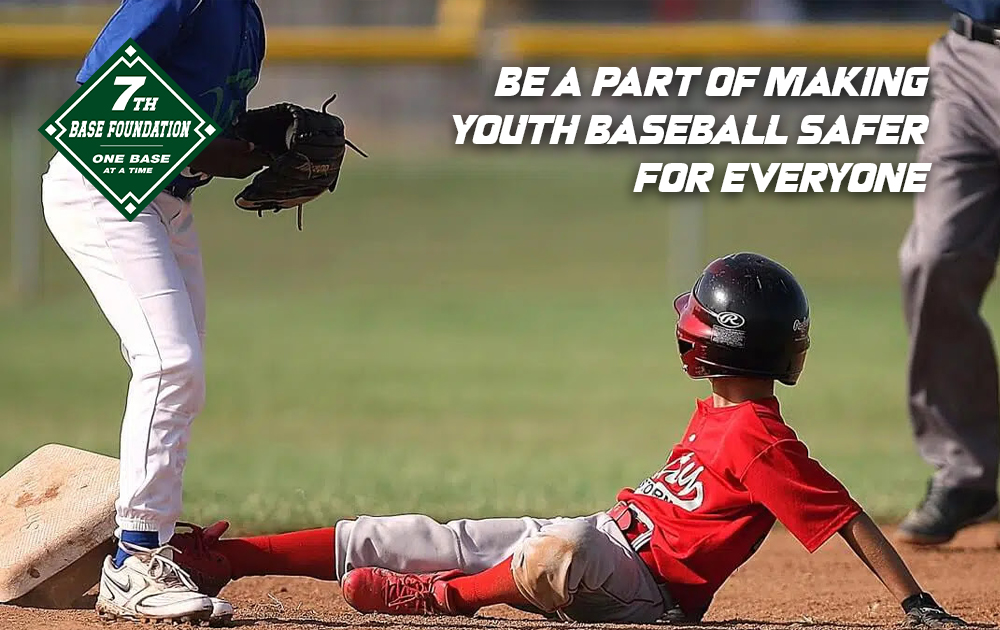
Share what you learn. Most parents don’t know that sliding into stationary bases is estimated to cause around 71% of recreational baseball and softball injuries. Say it once at a team parent meeting and you’ve meaningfully raised the odds that something changes.
Give at whatever level works. Small recurring gifts from parents who understand the stakes are among the most reliable funding we have.
If you’re a coach or league administrator
You have the authority to change your field, and probably more support than you think.
Do a base audit before your season. Document what you have. Photograph it. It takes twenty minutes and it becomes the backbone of any funding conversation you have afterward.
[Apply for bases](https://seventhbasefoundation.org/apply-for-bases/). We evaluate programs on demonstrated need, number of athletes impacted, program need and support, and organizational structure. Applications are reviewed by people, not filters, and selected organizations are notified directly, typically within a week.
Teach sliding properly. Equipment and technique work together. A breakaway base dramatically reduces the force a slide transfers to a young ankle and knee, but well-taught sliding mechanics — and a clear rule against head-first slides into a bag at younger ages — remain essential.
Tell other leagues. Your regional network of coaches and board members is the fastest distribution channel we have. Most leagues that need help have never heard of us.
If you own or run a business
Local businesses have sponsored youth sports for as long as youth sports have existed. This is a version of that with teeth.
Through community partnership, your business can fund safety equipment for fields in the communities you serve. Employees can volunteer together. Customers can be invited into a matching campaign. And the story you get to tell is unusually concrete: not “we support local sports,” but “we replaced the bases at three parks so kids don’t break ankles.”
Youth sports sponsorship is a crowded space. Child injury prevention is not.
If you played the game
Former players are our most instinctive supporters, because you already know what a bad base feels like.
You remember catching a cleat on a bag that didn’t give. You remember a teammate carried off the field. You remember which fields in your league were nice and which ones you dreaded.
Alumni groups, adult rec leagues, high school and college teams, and travel-ball organizations can all run fundraisers, dedicate a tournament, or sponsor a set of bases for the field where they came up. The symmetry of protecting the next kid on the field that made you is worth something.
If you work in health care
Physicians, athletic trainers, and physical therapists see the outcome of unsafe equipment more clearly than anyone. The American Academy of Orthopaedic Surgeons specifically recommends that physicians involved in sports activities actively promote the use of breakaway bases in their local communities.
A single conversation between a team physician and a league board carries more weight than a hundred social posts.
If what you have is time
Volunteering with us can mean outreach to leagues in your region, help at events, social media and storytelling, logistics coordination, or research into programs that need support. Tell us what you’re good at and we’ll find the place where it’s useful.
If all you can do is share
That’s not nothing. Our biggest obstacle isn’t skepticism — it’s obscurity. Leagues can’t apply for help they don’t know exists.
Post about it. Send our application page to the league president in your town. Bring it up in your team’s group chat. Follow and share our work on social media. Awareness is the cheapest, most scalable contribution anyone can make.
Everyone means everyone
This isn’t just about baseball, and it isn’t just about boys. More than two million girls between the ages of 12 and 18 compete in fast-pitch softball each year, in a sport where sliding is constant and the injury risk is identical. Every base we fund protects both.
It also isn’t just about the athletes with a future in the game. It’s about the kid who plays one season, has a good time, and never plays again — who deserves to walk away from that season with nothing worse than a grass stain.
Pick your role. Every one of them ends with a kid getting up from a slide and jogging back to the bag.