


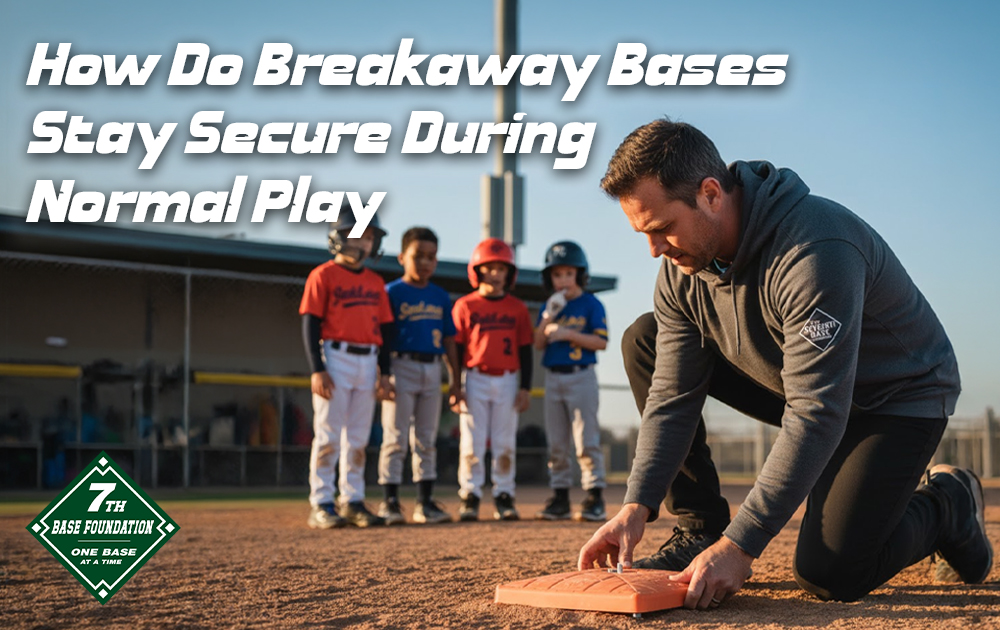
Almost every league that hears about breakaway bases for the first time asks the same question, usually within the first minute:
“So the base just comes off? Won’t that be a mess?”
It’s a fair question, and it deserves a real answer rather than reassurance. If a base could be knocked loose by a runner rounding the bag or a fielder planting a foot, the equipment would create more problems than it solved.
It can’t. Here’s why.
The system, not just the base
The first thing to understand is that a breakaway base isn’t a base sitting loose on the dirt. It’s a two-part system, and the anchoring half is the part that does the securing.
A traditional stationary base is bolted to a metal post sunk into the ground. Rigid, permanent, immovable — and, from a sliding runner’s point of view, a fixed obstacle.
A Rogers® Breakaway™ base works differently. An anchored rubber mat sits in the ground at the base position. Attached to that mat are grommets. The base itself snaps onto those grommets.
The mat and grommets don’t go anywhere. They’re anchored. What can release is only the top base — and only under a specific kind of force.
Two very different kinds of force
The reason the system works comes down to a distinction that’s obvious once you see it but easy to miss: the forces of normal play and the force of a slide are not the same thing.
Normal play generates force that is mostly downward and diagonal, spread across the surface of the base, and applied gradually. A runner touching first base at full speed presses down and pushes forward across a broad contact area. A fielder plants a cleat. A coach stands on the bag between innings. A runner takes a lead, dives back on a pickoff throw, rounds second on a double. All of that is load the base is designed to hold.
A slide generates force that is lateral, concentrated, and sudden. A body traveling along the ground drives into the edge of the base at a single point of contact — a foot, an ankle, a hand — and delivers a sharp horizontal impulse.
The grommet connection is engineered around that difference. It holds through the first category and releases under the second. The Foundation’s own description puts it plainly: although a sliding runner can dislodge it, the breakaway base is stable and will not detach during normal base running.
What counts as “normal play”
To be concrete, the base stays put through:
- Runners touching the bag at full speed on the way past
- Runners rounding the base on a turn
- Taking a lead and diving back on pickoff attempts
- Fielders planting, pivoting, and stretching for throws
- A first baseman holding the bag with a foot
- Coaches, umpires, and players standing on it
- Field maintenance, dragging, and raking around it
- Wind, rain, and normal weather
None of that involves a concentrated lateral impact, so none of it triggers a release.
What happens when it does release
When a slide does dislodge the base, the sequence is undramatic:
The base separates from the grommets and moves a short distance with the runner. The anchored mat stays exactly where it was, marking the base position precisely. The runner decelerates against something that gives rather than something that doesn’t.
Then someone picks the base up and snaps it back onto the grommets. It takes a few seconds and requires no tools.
There are two things worth noting here. First, the base does not disappear or become hard to locate — the anchored mat holds the position, so there’s no question about where it goes back. Second, a release is the system working, not failing. It should be treated like a foul ball: a normal event that briefly pauses play.
The most useful thing a league can do before its first game on new bases is brief coaches, umpires, and players on this. Once everyone understands that a dislodged base is expected behavior and takes five seconds to reset, the adjustment period is essentially over.
But doesn’t it slow the game down?
In practice, less than people expect, for a simple reason: not every slide dislodges the base. The release threshold is set for forceful impact, and plenty of slides — a hook slide that catches the corner, a controlled slide into a bag the runner reaches easily — don’t reach it.
When a release does happen, it’s a brief reset. Compare that to the alternative: a game stopped for an injured child, a parent called onto the field, and a season interrupted. The time comparison isn’t close.
Little League International has required disengage-able bases in U.S. leagues since the 2008 season under Rule 1.06. Hundreds of thousands of games have been played on them since. If the interruptions were disruptive at any meaningful scale, that requirement would not have survived.
Can a runner exploit it?
Occasionally someone asks whether a player might deliberately dislodge the base to gain an advantage — knocking it away and claiming the runner missed it, or arguing about position.
The anchored mat answers this. Because the mat holds the exact base position, there’s no ambiguity about where the base was. Umpires call the play on the position, not the loose base. And the release requires genuine sliding force, so it isn’t something a runner can trigger casually.
Durability and upkeep
Breakaway systems are designed for the wear of a real season. Rogers Base Company brings decades of manufacturing experience to this equipment, and the Rogers Breakaway™ system was developed through years of clinical research, testing, and refinement — it’s widely regarded as the de facto standard and has protected players of all ages.
Maintenance is straightforward. Add a base check to your pre-season field walkthrough and periodic in-season inspections: look at the grommets for wear, confirm the mat is properly seated and anchored, and check the base surface for damage.
One more practical point that removes a common objection: most breakaway bases fit standard field anchors, which makes conversion a straightforward equipment swap rather than a construction project.
The short version
A breakaway base is secure because the securing is done by an anchored mat and grommet system, and because the release threshold is calibrated to a force profile that only a slide produces.
It holds when it should. It gives when it should. That’s the entire design.
If your league has questions about how the system would work on your fields, get in touch — or apply for bases and let us help you make the switch.