
Walk onto a youth baseball field on a Saturday morning and you’ll notice the things everyone notices. The chalk lines. The dugout chatter. A coach hitting infield practice. Parents lining up along the fence with coffee cups and folding chairs.
What almost nobody notices is the base.
That’s the part of the field we think about every single day.
The problem hiding in plain sight
More than 40 million people take part in organized baseball and softball in the United States every year. It is one of the most participated-in sports in the country, and for millions of kids it is their first real experience of being part of a team.
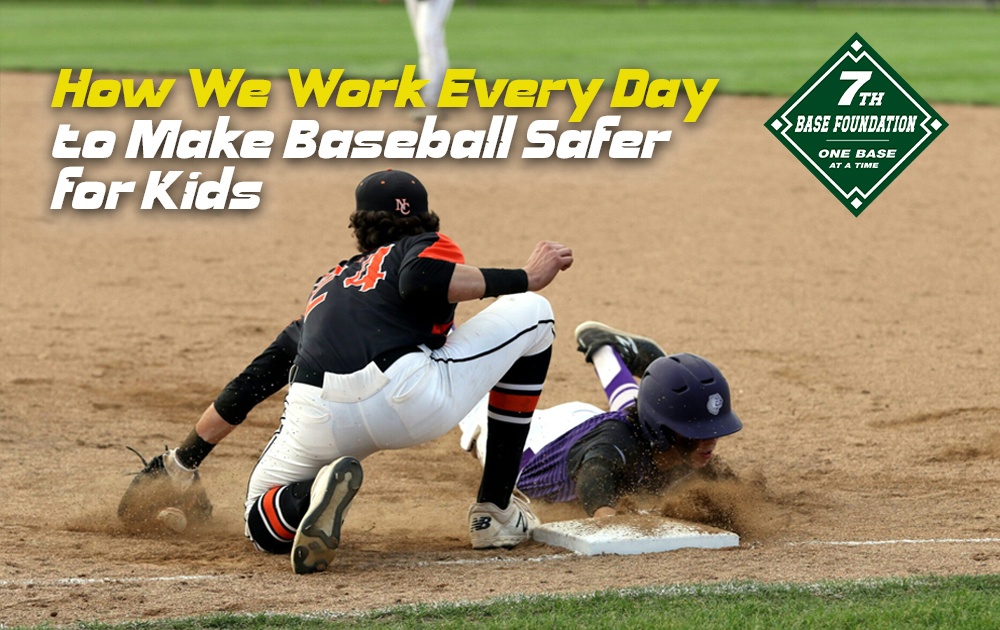
It is also a sport with a specific, well-documented injury pattern. Reporting compiled by the Centers for Disease Control and Prevention, the Journal of the American Medical Association, and other outlets has estimated that sliding into stationary bases accounts for roughly 71% of injuries in recreational baseball and softball. The U.S. Consumer Product Safety Commission recorded more than 629,000 baseball and softball injuries treated in 2014 alone.
Here is what makes those numbers hard to sit with: a very large share of them are preventable with equipment that already exists, already works, and already has the endorsement of the American Academy of Orthopaedic Surgeons.
That gap — between what we know how to prevent and what actually gets prevented — is the reason the Seventh Base Foundation exists.
Where our work starts
Our founder, Zachary H. Ritts, grew up playing Little League® in Santa Monica, California, on well-kept fields with proper equipment. Playing across greater Los Angeles, he saw how uneven that experience was from one neighborhood to the next. Some programs had everything. Some were holding a field together with donated gear and volunteer weekends.
That contrast stayed with him through high school and into NCAA Division III baseball, where he became known for his speed on the basepaths — and where he watched teammates and opponents get hurt on worn, outdated, and unsafe bases. The name “Seventh Base” comes from a game in which he stole seven bases, setting a conference record that still stands as the second-highest single-game total ever recorded by an NCAA Division III player.
The mission that grew out of it is narrower than most nonprofits and deliberately so: one base at a time.
What “every day” actually looks like
People sometimes assume a foundation like ours mostly writes checks. The check is the last step. Here is what fills the days before it.
Finding the leagues that need us most. Some programs come to us through our application. Many don’t, because they don’t know we exist. So we spend real time reaching out — to league presidents, parks and recreation departments, school athletic directors, regional Little League® and PONY administrators — asking a simple question: what’s the condition of your bases right now?
Reviewing applications carefully. Every application gets read by a person. We look at demonstrated need for breakaway bases, the number of athletes a program serves, the program’s own support and resources, and how the organization is structured. We aim to notify selected organizations directly within one week of application, because leagues are working against a season calendar and a vague “we’ll be in touch” doesn’t help anyone plan.
Making sure the equipment is the right equipment. Not every safety base performs the same way under impact, and we care about that difference. We fund Rogers® Breakaway™ bases, a system refined over years of clinical research and testing, and the one that has consistently shown the strongest results in independent biomechanical comparison. Depending on a field’s configuration, that might be an Original BreakAway™ set, a Change-Up BreakAway™ set, or a configuration with a double first base for younger divisions.
Sorting out the unglamorous logistics. Anchor compatibility. Field dimensions. Delivery windows that land before opening day rather than after it. Who on the league’s side will actually be at the field to receive the shipment. This is where good intentions usually die in youth sports, so it’s where we spend a disproportionate amount of our attention.
Educating, constantly. A surprising number of coaches and board members have never been told that stationary bases are the leading cause of injury in their sport, or that Little League International mandated disengage-able bases for all U.S. leagues starting with the 2008 season under Rule 1.06. Every conversation that ends with someone saying “I had no idea” is a conversation that pays off later.
Building the network. Our board includes people who know this world from the inside — an MLB pitching coach, the owner of Rogers Base Company, senior sports media executives, and a CPA who keeps our finances clean and accountable. That mix is intentional. It gives us credibility with leagues, quality control on equipment, and discipline with donor dollars.
What we measure
We keep our scorecard simple, because a complicated scorecard is usually a way of hiding from a simple one:
- How many fields have been converted from stationary to breakaway bases
- How many athletes play on those fields each season
- How quickly an application turns into installed equipment
- What share of every dollar reaches a field
Bases are durable. A set funded this spring will serve practices, regular-season games, tournaments, and All-Stars for years — which means each one protects wave after wave of kids, not just this season’s roster.
Why the daily part matters
Injury prevention is not dramatic. Nobody films the slide that didn’t end in an ankle fracture. There’s no highlight reel for the season a shortstop didn’t miss, the surgery a family didn’t pay for, the kid who didn’t quit the sport because of a bad experience at second base.
The absence of harm is invisible by definition. That’s exactly why it needs someone showing up for it every day — not once a season, not when a story goes viral, but consistently, field by field, base by base.
Where you come in
We are the only nonprofit in the United States devoted solely to preventing injuries by funding breakaway bases for youth baseball and softball programs. That focus is our strength, and it’s also why we depend entirely on people who decide this matters.
If you run a league, apply for bases. If you want to protect kids you’ll never meet, make a donation. If you have time and skills to offer, become a volunteer.
The kids on the field tomorrow morning won’t be thinking about their bases. That’s the whole point.